THE DASHBOARD
Five screens
you rarely need.
Most vendors sell you a screen and call that the product. Here the screen is the evidence. Skuply keeps working without anybody logging in; the dashboard is there to see what happened and to clear the review list.
This is a working example with invented product data, not a customer’s login.
THE OVERVIEW
Four counters, and not one of them is a vanity metric.
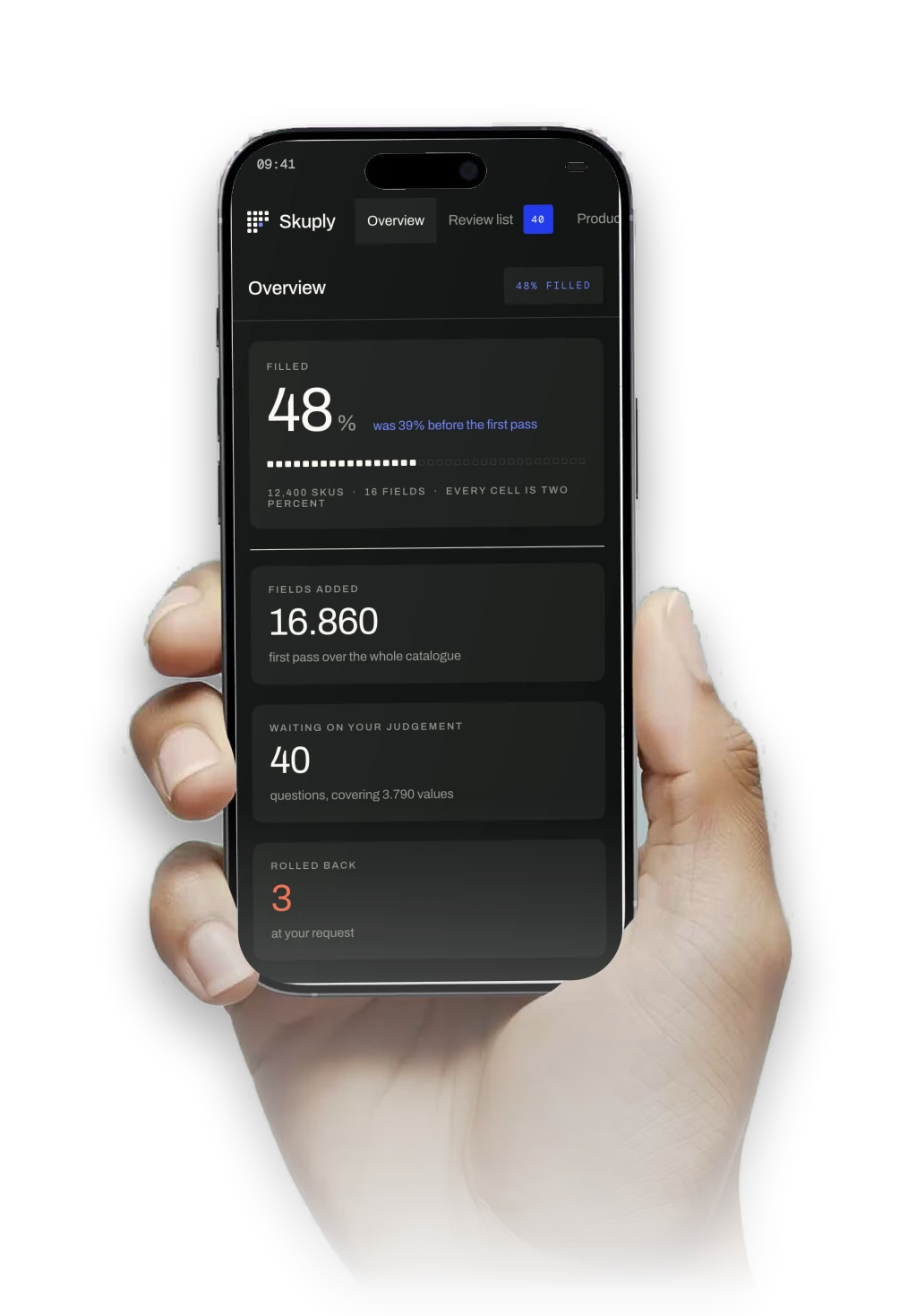
The first screen answers four questions: how complete is the catalogue, what was added this month, what is waiting on a judgement from you, and what has been rolled back. That last one is there on purpose. A vendor showing only its successes is hiding the rest.
Completeness
One number across the sixteen fields we read, with the denominator and the measurement date attached. Underneath it stand the four we actually fill.
Fields filled
What was actually written. Not what was proposed: what is standing in your shop.
Waiting on judgement
The length of the review list, with an honest estimate of how much time it takes.
Rolled back
What you rejected after it had gone live. This number belongs there, also when it does not flatter us.
The two charts underneath are built out of the brand mark itself rather than a charting library: the cell is the unit and the legend is the scale. No axes, no gridlines, no percentage without a denominator.
THE REVIEW LIST
The one screen where you actually have to do something.
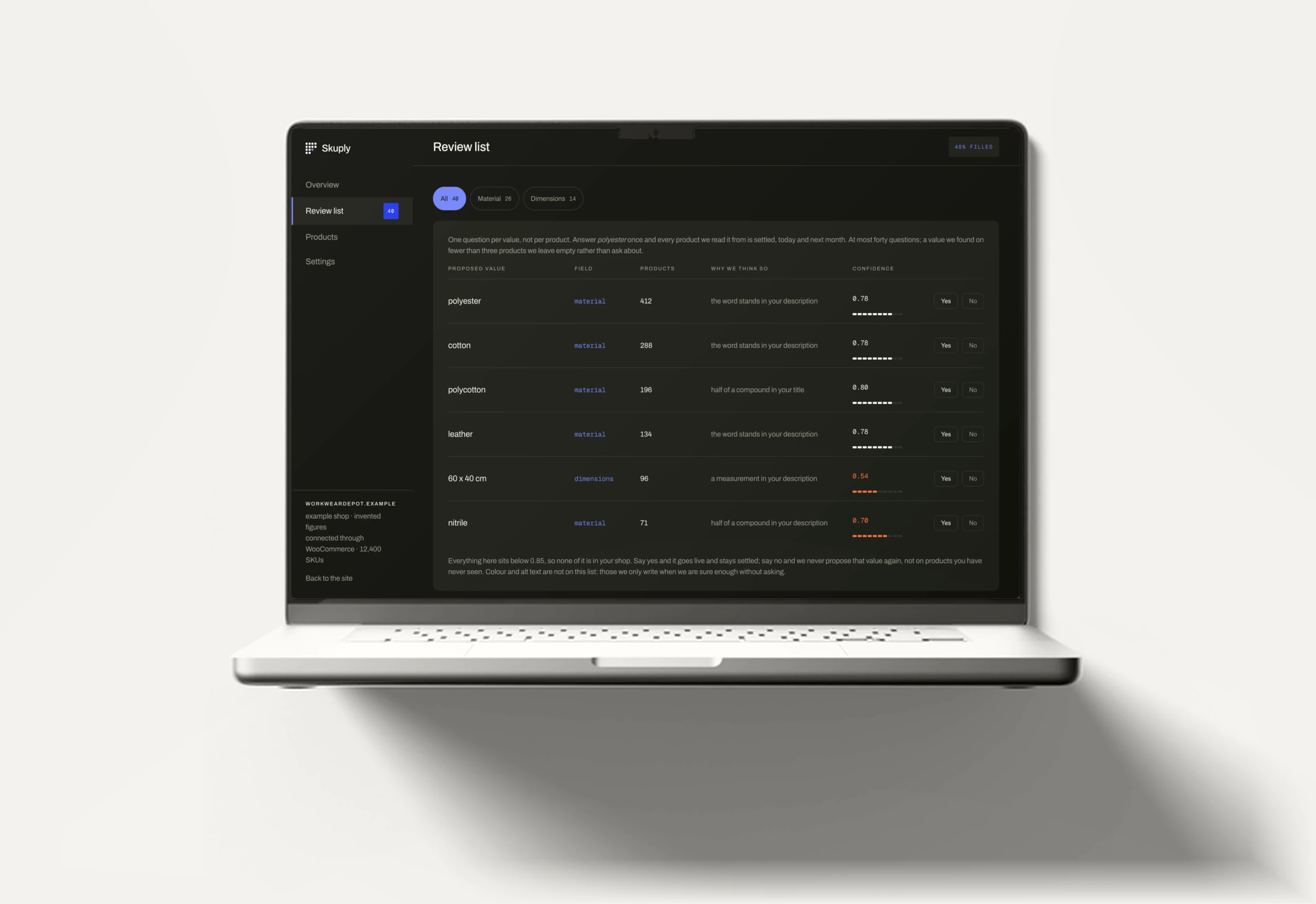
Everything that stayed below the threshold ends up here, grouped by value rather than by product. One row is one decision: polyester, material, 412 products. Answer it once and those 412 are settled, today and next month. At most forty rows, because a list of six hundred is work we sold you rather than took off your hands.
WHAT EACH ROW CARRIES
the value
what we would write, and in which field
how many products
how much one answer settles
where we read it
your title, your description, or half of a compound word
confidence
the number the value stayed below the threshold with
why we are asking
for instance: read from a description, where a word is often about something else
A no means we never propose that value again, not even on products you have never seen, and the rule it came from is recalibrated for your shop. A yes holds just as long. That is why month two is about what is new and not about the same list again.
PRODUCTS AND PROVENANCE
Every value carries where it came from.
The product list filters on what is empty, not only on what is filled. That sounds like a detail and it is the entire reason the screen exists: you are not looking for a product, you are looking for a gap.
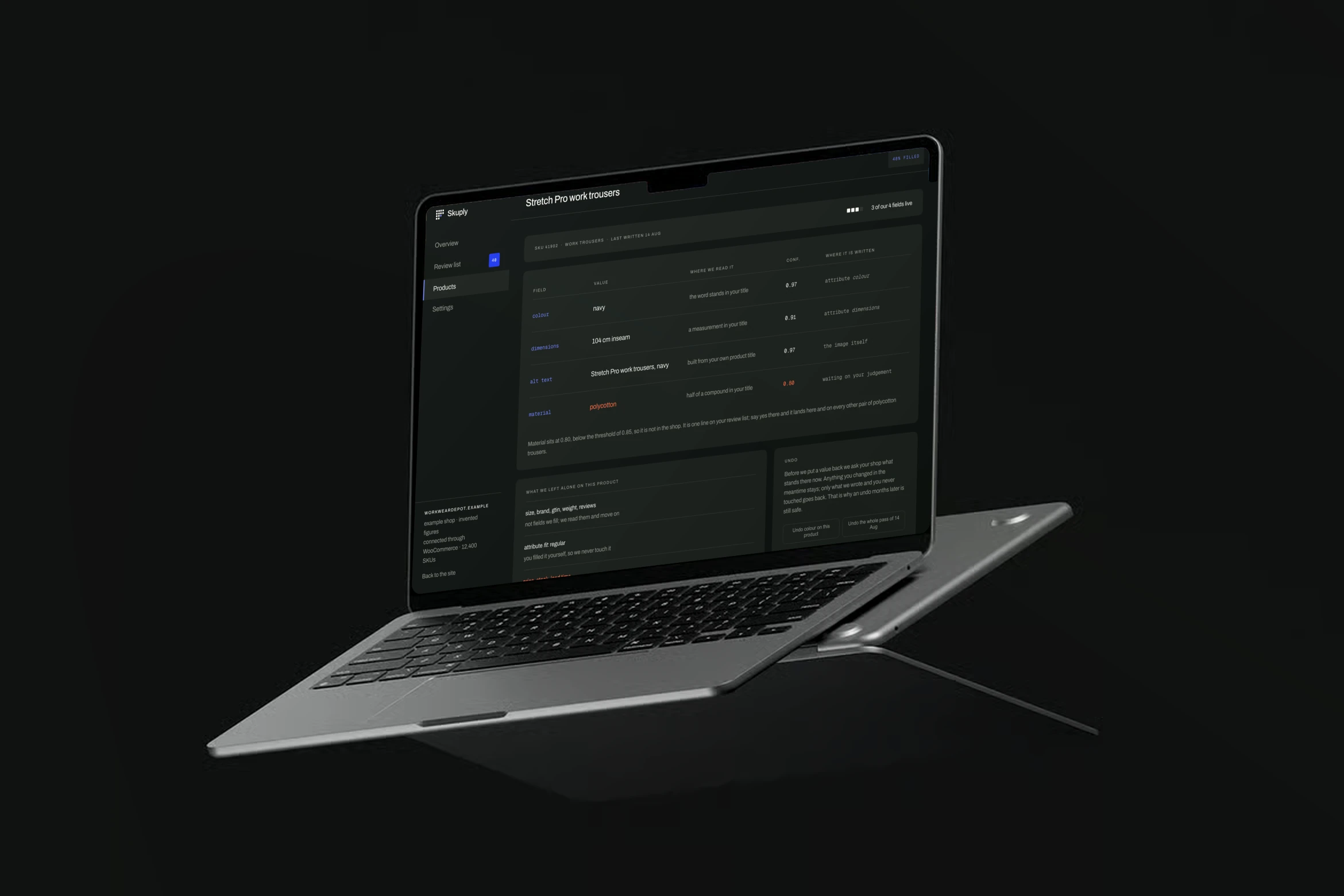
Click through to a product and you see, per field, the value, where we read it and the confidence. On WooCommerce it is written as a plain attribute your theme already shows; on Shopify in a namespace of our own, because there we cannot read back what stood there before and that is the only way an undo can be honest.
THREE KINDS OF PROVENANCE
1
Your title
a word or a measurement standing in the product name
2
Your description
the same, one sentence further in, and held to a higher bar
3
Yours
what was already there, and what we left standing
There is no fourth. We do not buy data in, and we do not invent it: every value we write already stood somewhere in your own shop.
One product, field by field.
Per field the value, where we read it and the confidence, on one line. What we wrote is marked as ours and what was already yours stays marked as yours, which is what makes an undo months later possible.
Before we put anything back we ask your shop what stands there now, so whatever you changed in the meantime stays where it is.
SETTINGS
Where the bar sits, and why you cannot move it.
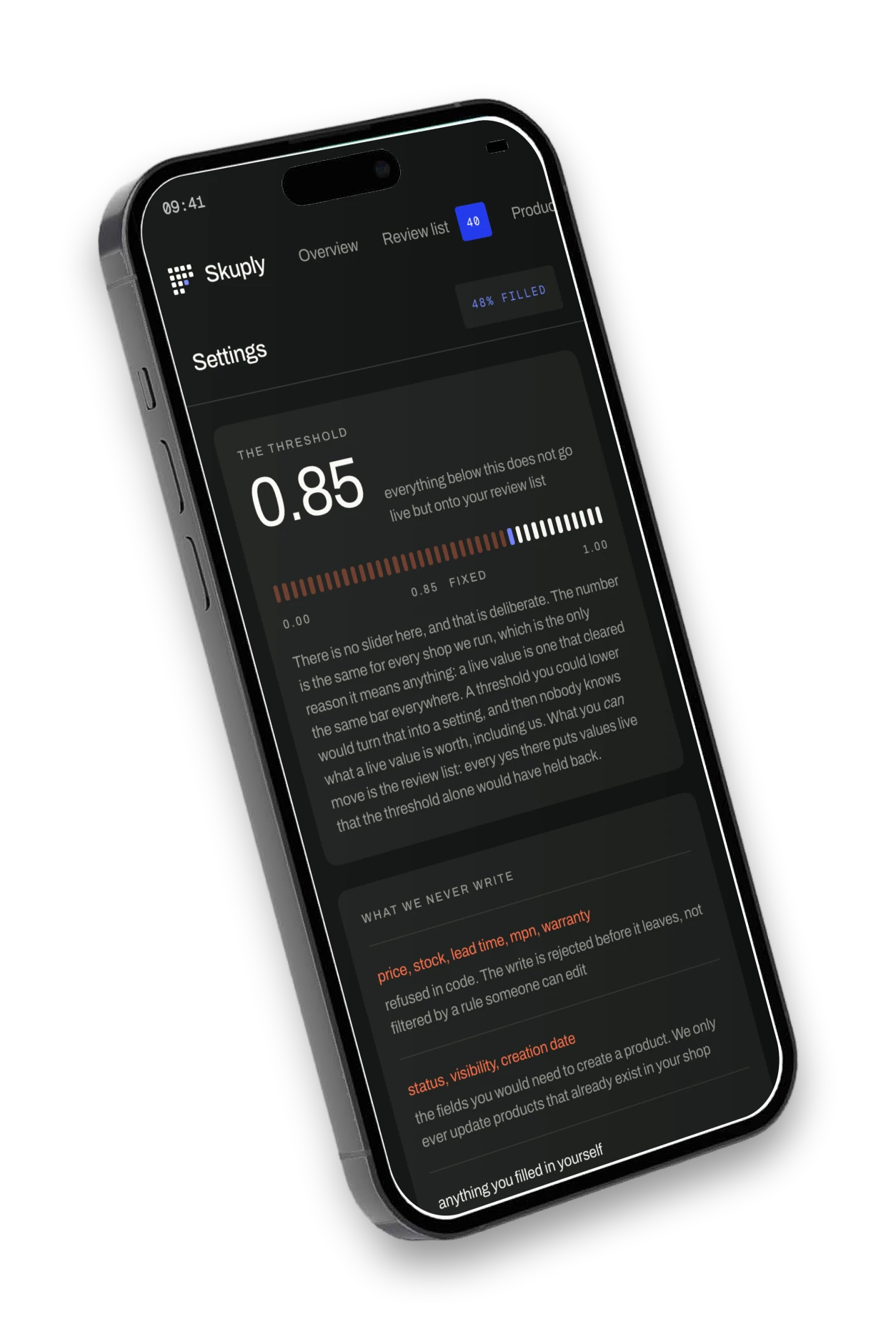
The threshold
0.85, the same for every shop we run. Not a slider: a number that means the same thing everywhere is worth something, a number each customer sets is worth nothing.
What we never write
Price, stock and lead time are refused in code, together with the fields you would need to create a product. We only ever update products that already exist in your shop.
The connection
The key you made in your own WordPress and can revoke there, what we may read and write with it, and when we run: once a day.
The threshold sits at 0.85 and stays there. What you can move is the review list: every yes puts values live that the threshold alone would have held back, and it holds for good. Why the number is fixed is on Safety.
Nothing here is a dial.
The settings screen is mostly a list of things we will not do: the fields we refuse in code, the products in your holdout, and everything you filled in yourself.
The one button that does something is undo. Per value, per field or per whole pass, months afterwards.
AND OTHERWISE
If you never log in, you still know.
Every month a report lands in the inbox with the same numbers: the score, what was added, the review list and the holdout. One page, forwardable to somebody who has no time to log in. The dashboard adds depth to that, not a different story.